FiboSearch 2.0 is on the way: what we’re rebuilding and why


 Max 4min read
 If you’ve been following FiboSearch over the past few years, you might be wondering how it’s evolving. The short answer: it is, and in ways that aren’t always visible at first glance.
Over the past two years, much of our focus has gone into building our second product, FiboFilters, which, together with FiboSearch, forms the foundation of product discovery in e-commerce. In 2026, our focus shifts back to FiboSearch. After a deep look at the market and where it’s heading, we’ve decided to rebuild key parts of the plugin so it aligns with how online stores are evolving.
What has changed in WooCommerce search
Today, stores expect more than a simple autocomplete that lists matching products or categories. Many of these capabilities already exist in FiboSearch, including handling imperfect queries, recovering from zero-results, and working across different plugins and themes.
What has changed are expectations. These capabilities now need to work more consistently, feel more intuitive, and require less manual tweaking or support involvement.
Search is becoming a full discovery layer. It should guide users toward the right products, categories, or filters, while giving merchants clear control over relevance and actionable insights about what to improve. All of this should work without relying on custom code or trial-and-error.
What we’ve learned from real stores
We’ve analyzed the majority of our support tickets and user feedback from the past 7 years, and a few patterns have become very clear.
Dozens of different product catalog types
We’ve worked with a wide range of product catalogs across WooCommerce. These include fashion, automotive parts, printers and cartridges, electronics, home and furniture, cosmetics and beauty, sports equipment, DIY and tools, pet supplies, books and media, medical supplies, and industrial components, as well as many other types.
Each of these catalog types behaves differently. They vary in how users search, how products are structured, and what “good search” actually means in practice.
This is where things get complicated. Because every catalog has its own logic, there is no single global setup that works well everywhere. A change that improves results for one store can easily make results worse for another.
In practice, this often meant store owners had to reach out to our support team to fine-tune FiboSearch for their specific catalog. We helped adjust the search engine behavior, improve zero-results recovery, and sometimes even tweak the presentation layer to better match how users browse that particular type of products.
While this approach worked, it also showed a clear limitation. Too much of the product’s power depended on manual tuning and support involvement instead of being built into the product itself.
Index reliability across different hosting environments
FiboSearch Pro uses its own search index based on an inverted index, which allows us to search through very large catalogs with hundreds of thousands of products, often in just a few milliseconds. To make this work, the index must be stored in dedicated database tables and updated incrementally so it always reflects the current state of the catalog.
Running such a system is not difficult in a single, controlled environment. The challenge begins when it has to work across thousands of different hosting setups, each with its own limitations, configurations, plugins, and software versions.
In 2020, our internal data showed that roughly 5% to 8% of indexes failed to build correctly for various reasons. Over the years, we reduced this number to around 1.5% thanks to improvements in the codebase and a huge amount of work from our support team.
At this point, however, we’ve reached the limit of what can be improved within the current architecture. Getting closer to full reliability requires a new approach to how the index is built and maintained, not just incremental fixes.
FiboSearch 2.0 is more than a UI refresh
More reliable search
We are rebuilding the core so search is easier to trust in everyday use. That means clearer diagnostics, more reliable indexing, and faster ways to understand why something is missing. Instead of guessing or reaching out to support, store owners should be able to see what’s happening and fix it quickly.
This matters because the biggest frustration we’ve seen over the years is not speed or UI. There is uncertainty about the results and a lack of confidence that the index reflects the real catalog.
Better relevance
We are strengthening the foundation, so search works correctly by default, not only after manual tuning. This includes better handling of typos, query normalization, and more consistent treatment of codes, models, plural and singular forms, and transliteration.
FiboSearch already supports scoring, fuzzy matching, and synonyms. The goal now is to make relevance more automatic and more predictable, so merchants spend less time fixing queries and more time improving their catalog.
More control
We are simplifying how relevance is configured so it becomes clear and accessible, not something hidden behind hooks and custom code. Merchants should be able to understand what influences ranking and adjust it without technical workarounds.
The goal is not to add more settings. It is to provide the right level of control, with clear rules and understandable outcomes.
Smarter analytics
We are evolving analytics from simple reporting into practical guidance. Instead of only showing what users search for, it should help answer what needs to be improved and where search is failing.
This means connecting search data with real outcomes and giving merchants actionable insights, so they can make better decisions without relying on trial and error.
What we’re focusing on first
We are starting with a set of changes that directly address the most common problems we’ve seen across real stores.
A completely rebuilt, merchant-oriented settings experience
We are redesigning the settings from the ground up so they are focused on real store scenarios, not technical configuration. The goal is to make it fast and intuitive to adapt search to a specific catalog, without relying on custom code or support.
Instead of scattered options, merchants will be able to understand how search works, adjust it with confidence, and quickly match it to their product type and business needs.
Full control over the three search states
Search does not start when a user types. It starts before that, and it continues even when no results are found. We are introducing clear control over three key states:
- Before typing: what users see when they focus the search bar, such as recent searches, popular queries, or suggested products
- While typing: how autocomplete behaves, what it shows, and how results are structured
- Zero-results state: how search recovers when nothing is found, including suggestions, fallbacks, and alternative paths
Each of these states will become more configurable and easier to shape, so merchants can control more of the search experience, not just the final results.
Stronger and more predictable relevance foundations
We are improving the core logic so results are more consistent, easier to understand, and less dependent on manual fixes. This includes better handling of common query issues and a clearer internal structure for ranking.
The goal is simple: better results out of the box, with fewer edge cases that require intervention.
Better diagnostics and visibility into search behavior
We are adding tools that help merchants see what is happening inside the search engine. This includes understanding why products are missing, how queries are interpreted, and where things go wrong.
Instead of guessing, merchants will have clear signals and explanations, making it easier to debug and improve search performance.
Foundations for actionable analytics
We are expanding analytics so it becomes a practical decision-making tool, not just a reporting layer. Merchants will be able to see which queries fail, where users struggle, and what can be improved next.
This is about turning data into clear next steps, not just charts.
Preparing the ground for a complete discovery layer
FiboSearch and FiboFilters have always solved different parts of the same problem. One helps users find products faster, the other helps them narrow down choices and explore catalogs more efficiently.
Until now, these have been two separate tools that can work together. Going forward, the direction is much clearer. We are gradually bringing them closer so they can act as one consistent product discovery layer for WooCommerce.
This does not mean merging everything into a single, complex system overnight. It means building a shared foundation, where search and filtering understand the same data, follow the same logic, and support each other across the entire user journey.
The goal is simple. Instead of treating search and filtering as separate features, we are moving toward a model where they work together as one coherent discovery experience.
This is a longer-term direction, but FiboSearch 2.0 is the first step toward making it possible.
What this means for store owners and developers
All of this leads to a simple outcome. FiboSearch should become easier to trust, easier to adapt, and easier to improve over time.
Store owners will spend less time fixing search manually and more time working on their catalog and business. Developers will spend less time debugging edge cases and more time building real value.
It is also important to clarify one common misconception. This is not about turning FiboSearch into an AI-driven search engine where every query is handled by a language model.
Search in FiboSearch 2.0 remains fast, deterministic, and self-hosted, just as it should be for WooCommerce.
Where AI comes into play is after the fact, as a supporting layer. It can help analyze search data, highlight patterns, and suggest improvements. For example, it can point out missing synonyms, detect queries with poor results, or recommend changes in ranking.
The goal is not to replace the search engine with AI. The goal is to help merchants make better decisions based on real data, without guesswork.
In other words, AI becomes an assistant for improving search, not the engine that runs it.
FiboSearch 2.0: Behind the Scenes
This section is a place for small, informal glimpses from our work on FiboSearch 2.0, early screenshots, interface ideas, experiments, and other behind-the-scenes notes.
Some of these things may change, some may never ship exactly as shown, but we want to share more of the process as we go.
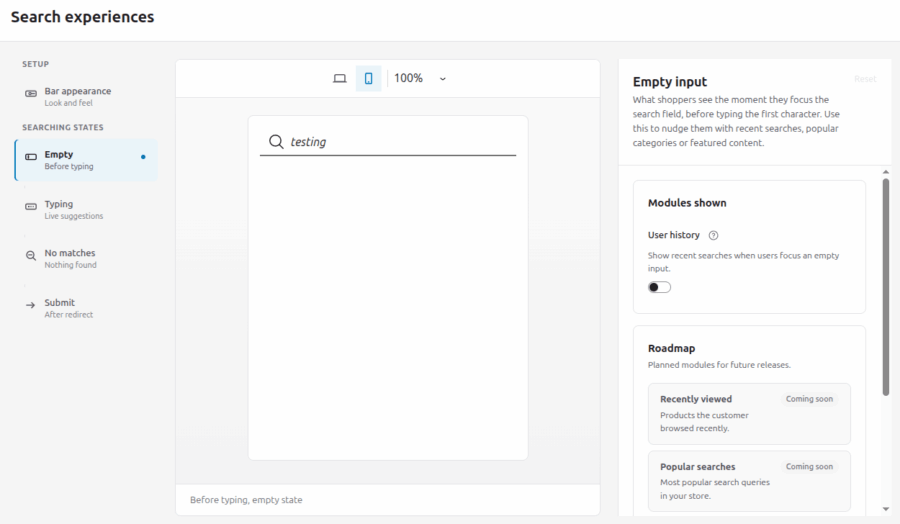
Prototype of the “Search Experience” settings tab. May 15, 2026.
A fundamental change will be the reorganization of the plugin settings. The search bar builder will be similar to the block editor. On the left side, users will be able to choose sections with general search bar settings, as well as different states displayed during search. On the right side, the settings for the selected section will be available. The central area will show a real-time preview.

10 comments
We are developers and work with many different tools on a daily basis. Overall, we are quite happy with yours, but as some users have already mentioned, it can feel a bit limited for certain projects.
One feature that would be fantastic is the ability to integrate filters directly into the search interface without requiring custom development or programming. This would make implementation much easier and more accessible for many users.
We also miss having more customization options. In some cases, the search experience feels too basic and lacks visual appeal. It would be great to have the flexibility to display results in different layouts, such as cards, grids, lists, or other formats, as well as options for image sizes, product thumbnails, typography, titles, spacing, and overall styling.
Compared to the excellent work you’ve already done, these enhancements seem relatively minor from a development perspective, but they could significantly improve both the product and the user experience.
Give it a try!
I’d be happy to test this version. It sounds promising.
As another user already mentioned, we use and highly value your project. Performance is extremely important when working with large product catalogs containing many references.
In addition, the integration between FiboSearch and FiboFilters directly within the search experience significantly improves the user experience, making it easier and faster for customers to find exactly what they are looking for.
We’re happy to help and provide feedback!
Hi Fibosearch Team,
I would be glad if i could help!
Thank you!
Thanks for your interest in testing. Please sign up for the newsletter below if you haven’t already. We may start inviting users to the first beta tests around Q4 2026, or possibly earlier.
We’ll also be sharing occasional behind-the-scenes glimpses from our work in this section: https://fibosearch.com/fibosearch-2-0-is-on-the-way/#fibosearch-20-behind-the-scenes
It will be awesome to use the fibosearch2.0 early.
Hola,
Me gustaría poder probar el acceso anticipado de FiboSearch 2.0.
Trabajo habitualmente con tiendas WooCommerce y FiboSearch es un plugin que utilizamos o valoramos especialmente en proyectos donde la búsqueda de productos es importante. Me interesa mucho probar las mejoras relacionadas con la relevancia de resultados, la indexación, los diagnósticos y la nueva experiencia de configuración.
También me parece especialmente interesante la integración progresiva entre FiboSearch y FiboFilters, ya que en muchos catálogos la búsqueda y el filtrado forman parte de la misma experiencia de descubrimiento de producto.
Podría probar el plugin en entornos reales o de staging, revisar cómo se comporta con diferentes tipos de catálogos y compartir feedback sobre la configuración, los resultados de búsqueda y posibles casos problemáticos.
Me gustaría formar parte del grupo de acceso anticipado y ayudar a validar FiboSearch 2.0 antes de su lanzamiento.
Gracias.
I would be great to try the new plugin. In fact i requested several times to enchanched the way that fibosearch shows the results, I will be more than happy to give feedback after using several SAAS for woocommerce search.
Use version, version 1 is becomming gltchy on Mobile and does not do overlay on Mobile anymore
i want to try fibosearch 2.0
i’ll be so thankful to use the new 2.0 plugin !